
Feeling like your iPhone and TV are speaking two entirely different languages? You click the mirroring icon, wait with bated breath, and… absolutely nothing happens. Or worse, your television screen goes pitch black while the audio mockingly plays in the background like a ghostly radio broadcast.
When screen mirroring works, it feels like pure digital magic. But when it fails, it is one of the most frustrating tech hiccups you can encounter. Whether you are trying to share family vacation photos, cast a business presentation, or stream your favorite show, we have all been there.
Fortunately, most casting glitches boil down to a few common culprits. Below is your comprehensive, human-friendly troubleshooting blueprint to fixing your connection issues for good.
1. The “Golden Rule” of Mirroring: The One-Network Check
The single most common reason screen mirroring fails is that your devices are technically “in different rooms” digitally. For AirPlay or mirroring protocols to establish a handshake, your sender (the iPhone) and your receiver (the Smart TV, PC, or streaming stick) must be on the exact same network segment.
How to Check Your Network SSID:
- Open your iPhone’s Control Center (swipe down from the top-right corner on modern iPhones).
- Long-press the Wi-Fi icon to bring up your current network name.
- Head to the network or network information settings on your TV or computer and verify that the name (SSID) matches your phone down to the exact character.
⚠️ Watch out for “Guest” networks or dual-band routers: Many modern routers split their signals into $2.4\text{ GHz}$ and $5\text{ GHz}$ bands with similar names, or broadcast a separate “Guest” network. If your iPhone is casually lounging on the $5\text{ GHz}$ band while your TV is chugging along on the $2.4\text{ GHz}$ band, they won’t talk to each other. Switch them to the identical band.
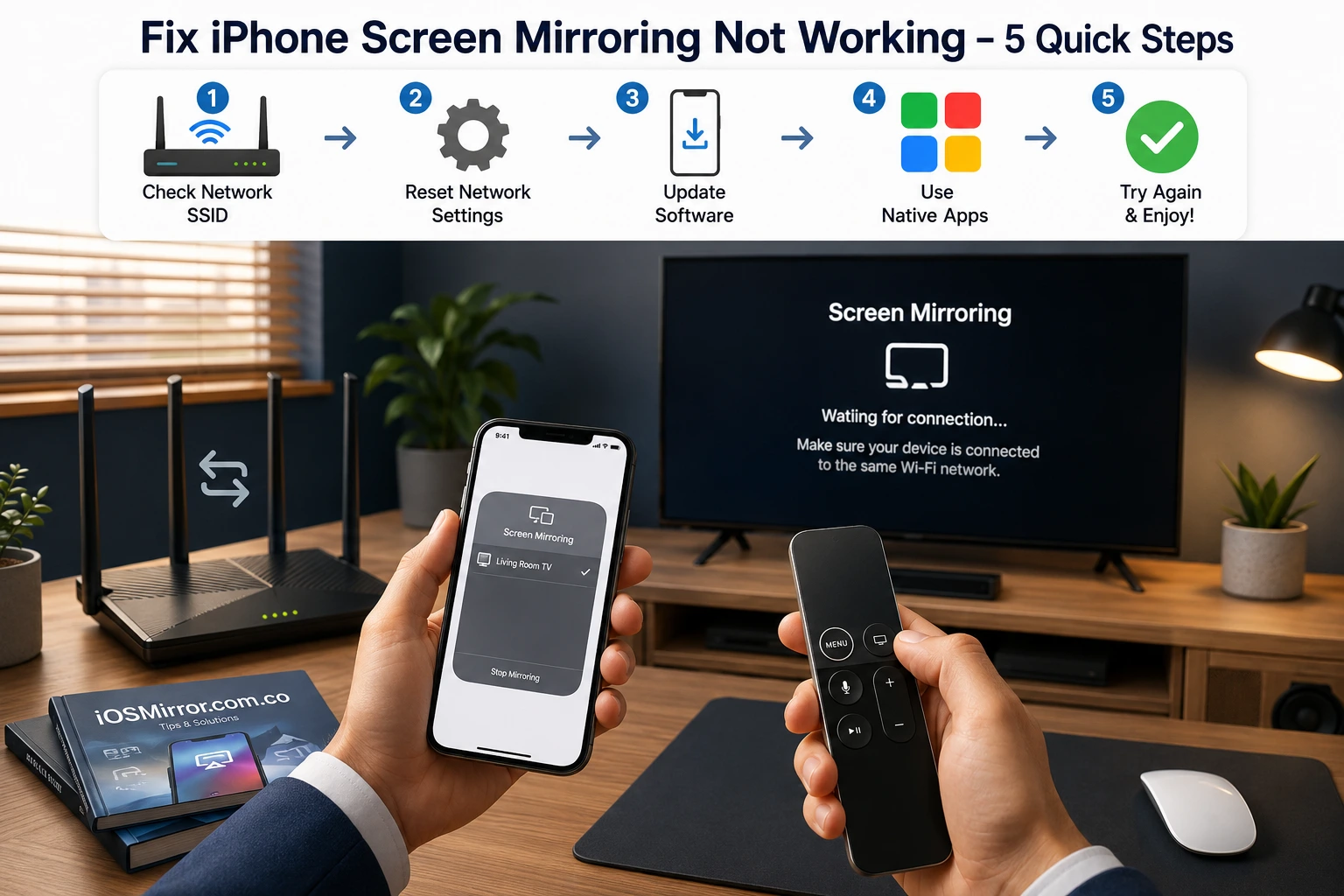
Refer to the visual checklist below to see exactly how your local environment should interact.
+-----------------------------------------------------------------------+
| 1. Check Network SSID -> 2. Reset Network -> 3. Update -> 4. Use Apps |
+-----------------------------------------------------------------------+
For a complete visual overview of these steps happening simultaneously in a real-world setup, you can reference watermarked_img_13095566053851187641.png.
2. Why is My Screen Black? (The DRM Mystery)
You have successfully paired your phone, you can see your iOS home screen perfectly on the television, but the millisecond you hit “Play” on Netflix, Disney+, or Prime Video, the TV screen goes completely black. The audio keeps playing perfectly, but the video vanishes.
What is happening? You haven’t broken anything. This is a built-in feature called DRM (Digital Rights Management). Premium streaming applications intentionally encrypt their video feeds to prevent people from illicitly recording or broadcasting copyrighted content over external screen-sharing tools.
How to bypass the black screen:
- Lean on Native Apps: Instead of mirroring your entire phone screen to watch a movie, download the native app (e.g., the YouTube or Netflix app) directly onto your Smart TV, Roku, or Firestick.
- Cast Instead of Mirroring: Look for the dedicated “Cast” icon (a rectangle with Wi-Fi waves in the corner) right inside the video player rather than toggling “Screen Mirroring” from your global Control Center. Media casting sends a direct stream link to the TV rather than video-encoding your phone’s physical display, which frequently gets around strict DRM blocks.
- Inspect Physical Links: If you are using a physical Lightning or USB-C to HDMI adapter, ensure it is officially certified and supports HDCP (High-bandwidth Digital Content Protection). Cheap, unbranded adapters fail HDCP handshakes automatically, resulting in video blackouts.
3. Banishing the “Lag Monster”
Nothing ruins a mobile gaming session or a clean work presentation faster than a painful 2-second delay. If your screen mirroring looks like a choppy slideshow or suffers from major audio-video desync, your local wireless environment is struggling under heavy data loads.
Follow the “3-Meter Rule”
Wireless streaming requires a massive amount of local bandwidth. For an optimal, uncompromised stream, keep your iPhone within 3 meters (roughly 10 feet) of your wireless router or the direct receiving device. Walls, heavy furniture, and physical distance degrade high-frequency signals rapidly.
Silence the Background Digital Noise
Your iPhone might silently be fighting for its life in the background while you stream.
- Navigate to Settings > General > Background App Refresh and turn it OFF temporarily. This stops non-essential apps from hogging your local bandwidth.
- Disable Low Power Mode. When active, Low Power Mode aggressively throttles your iPhone’s CPU performance. Screen mirroring relies heavily on the processor to compress and send video frames in real time, so keeping this setting off ensures a much higher frame rate.
4. The “Reset” Hierarchy
If you’ve verified your networks and your phone simply refuses to discover your TV—leaving you staring at an endless, spinning “Searching for Devices…” wheel—it’s time to force a fresh digital start. Do not just blindly reboot random electronics. Follow this strategic sequence to clear out stale cache files effectively:
Step 1: Power Cycle the Router
Unplug your home router from its power source, count to 30, and plug it back in. Routers manage a massive table of local IP addresses. Over time, these routing tables can get tangled, causing your TV and phone to become functionally invisible to one another.
Step 2: Cycle Bluetooth & Wi-Fi
On your iOS device, swipe into your Control Center, turn both Wi-Fi and Bluetooth completely off, wait 10 seconds, and turn them back on. AirPlay heavily relies on Bluetooth low-energy signals for the initial device discovery “handshake,” while using Wi-Fi for the heavy lifting of raw data transmission.
Step 3: Clear the Phone’s Network Cache
If the problem persists across multiple networks, it’s time to reset your device’s internal configurations.
- Go to Settings > General > Transfer or Reset iPhone.
- Select Reset and then tap Reset Network Settings.
⚠️ Note: This will delete your saved Wi-Fi networks and passwords, requiring you to type them back in, but it is an incredibly effective way to flush out stubborn network bugs.
Quick-Glance Troubleshooting Checklist
| Symptom | Primary Suspect | Instant Fix |
| TV Appears Missing from List | Network Isolation / Mismatch | Match your Wi-Fi SSIDs exactly |
| Audio Plays, Video is Missing | DRM Software Protection | Utilize the TV’s built-in native app |
| Severe Choppiness / Stuttering | Physical Signal Obstruction | Move closer to router; turn off Low Power Mode |
| Connection Constantly Drops | Stale Network Cache | Power cycle your home router |
Final Thoughts: Software Maintenance Matters
As software ecosystems evolve, minor bugs can occasionally slip into public releases. If your phone suddenly stops casting out of nowhere, verify that you aren’t falling behind on your system updates. Navigate to Settings > General > Software Update to ensure your phone has the latest optimizations.
Additionally, if you are actively participating in Apple’s Developer or Public Beta programs, keep in mind that beta operating systems are notoriously unstable when it comes to experimental network protocols. Rolling back to a standard consumer release can quickly restore consistency if screen mirroring is a vital part of your daily workflow.
By applying these practical, systematic adjustments, you can completely sidestep frustrating connectivity loops and get your content onto the big screen where it belongs.